Tuesday, August 9, 2011

Notre Dame Cathedral, Sainte Chapelle, Conciergerie

After our morning and early afternoonn walking tour in the Marais and our lunch near the Paris City Hall (Hotel de Ville), my granddaughter, grandson and I set out for Notre Dame Cathedral. We left the restaurant near the Hotel de Ville at 2:40 pm.

We crossed Rue de Rivoli and walked over to the Hotel de Ville, (http://en.wikipedia.org/wiki/H%C3%B4tel_de_Ville,_Paris), which has been at this location since 1357. The current building was completed in 1628. However, the interior was destroyed by a fire set by extremists in 1871. The inside was subsequently rebuilt during the period 1873 - 1892. The Hotel de Ville is a large and impressive building.
Hotel de Ville 
We walked along the east side of the building, on Rue de Lobau. There was a long line of people waiting to get into a free art exhibit entitled, “Paris at the Time of the Impressionists: The Masterpieces of the Musée d’Orsay at the Hotel de Ville.”

One entrance to the Hotel de Ville was guarded by two large bronze lion statues on stone pedestals.

At the southeast corner of the Hotel de Ville, we crossed the Quai de l’Hotel de Ville and turned right, walking along the Seine. In the middle of the Seine, we could see the Île de la Cité, the island where Notre Dame Cathedral and other historic buildings are located.

We walked about a block to Pont d’Arcole, a bridge that crossed over to Île de la Cité. We turned left and crossed the bridge.

Île de la Cité (http://en.wikipedia.org/wiki/%C3%8Ele_de_la_Cit%C3%A9) is one of two natural islands in the Seine River in Paris. The other island is its next-door neighbor, Île St. Louis. Île de la Cité is home to the Cathedral of Notre Dame, the church of Sainte Chapelle, the Conciergerie, the Tour de l’Horloge - with the oldest public clock in Paris, a flower market, a Sunday bird market, and the Ancien Cloître - an old residential quarter.

After crossing onto the island, we continued straight onto Rue d’Arcole, which was lined with souvenir shops. The sidewalk was crowded with tourists.

Seated next to a tree was a homeless man with his dog and her four puppies. Three of the puppies were nursing.

Notre Dame Cathedral

Two blocks from the bridge, we came to Notre Dame Cathedral, also known as Notre Dame de Paris (Our Lady of Paris), and the large square in front of it. We arrived there about 3:10 pm.

Notre Dame Cathedral (http://en.wikipedia.org/wik i/Notre_Dame_de_Paris, and http://www.notredamedeparis.fr/-English-, and http://www.sacred-destinations.com/france/paris-notre-dame-cathedral) is the cathedral of the Archdiocese of Paris. It is considered one of the finest examples of French Gothic architecture. Another cathedral, Sainte-Etienne (St. Stephen), originally stood on this site. However, Bishop Maurice de Sully, the Bishop of Paris in 1160, had something grander in mind. He had Saint-Etienne demolished and Notre Dame built in its stead. Construction started in 1163 and was not completed until 1345.

Before Notre Dame was built, the same site was occupied by other religious buildings - a Roman temple dedicated to Jupiter, then a Christian basilica, then a Romanesque church.

For some really great interior and exterior views of the Cathedral, go to the web site: http://www.fromparis.com/virtual-tour-notre-dame/. Then click on the red or blue dots on the Cathedral. Then move the page view down toward the bottom. You will see great virtual moving views of the area selected. (Make sure to go to the bottom picture, not the middle picture, which does not move.)

The Cathedral has a number of interesting features.

The exterior walls have additional support in the form of arches called “flying buttresses.” These were added when it was noticed that stress fractures were developing in the upper walls. Notre Dame was one of the first buildings in the world to have this feature.

It has beautiful stained glass windows, including the spectacular huge rose windows on the north, south, and west portals. Most of the original stained glass windows were destroyed during the Revolution. However, those on the north and south portals were spared.
A Rose Window 
The west facade - the front facade - has three portals, which are richly decorated with early Gothic art.

On the western facade is a row of statues representing biblical kings of Judah. French revolutionaries thought they were statues of French kings and beheaded all of them. In 1977, those heads were found buried nearby and are now on display in the Cluny Museum. The statues were later restored.

The Cathedral has two towers - a north tower and a south tower. They are 228 feet high. In the south tower is a huge bell that is named Emmanuel and that weights 13 tons.

The view from the rear of the outside (east side) offers a great view of soaring pinnacles and flying buttresses.
The Interior of Notre Dame

Notre Dame is reportedly visited by 13 million visitors a year - more than the Eiffel Tower.

It is important to remember that this is an active Catholic church.

Entry to the Cathedral itself is free. To visit the Cathedral towers, there is a charge of €7.50 for adults and no charge for children. There are 387 steps (no elevator) to the top. There are other viewpoints on the way up to the top. I could have could have used my Museum Pass to get into the towers without charge, but we decided against visiting the towers.

Photography is permitted inside the Cathedral, except during services.

Our Visit

We got into the long line in the square in front of the cathedral at about 3:12 pm. This square is known as the Parvis de Notre Dame. (A parvis is a courtyard at the entrance to a cathedral.) The Parvis itself was not particularly impressive, but its openness allowed a great view of the front of the cathedral. It was sunny while we were standing in line.

The Cathedral was on the east side of the Parvis. There were low buildings on the north and west sides. There were small trees on three sides, but not on the Cathedral side. There was a large equestrian statue of Charlemagne on the south side.

Fortunately, the line to enter the Cathedral moved very quickly, and we entered the Cathedral through the right front portal within 8 minutes of getting in line.

The cathedral was magnificent on both the outside and the inside. Although it has suffered serious damage due to religious sectarian divisions and revolutions, it has been nicely restored and is currently very beautiful.

 I have always been amazed, when I have seen ancient churches, palaces, monuments, and other grand buildings  in Paris, Mont St. Michel, Chartres, Istanbul, Rome, Seville, Toledo, Granada, Ephesus, Knossos, etc., that architects and engineers were able to build such immense, beautiful structures, without modern construction equipment and often with very innovative designs.

After enjoying the interior of the Cathedral, we walked out onto the Parvis through one of the west front portals.

Archaeological Crypt of the Parvis of Notre Dame

The next site on the agenda was the Archaeological Crypt of the Parvis of Notre Dame (Crypte Archéologique du Parvis Notre Dame) (http://www.crypte.paris.fr/en/crypt/more-2000-years-history), which was located right under the Parvis. The entrance to the Crypt is at the very western edge of the Parvis - the edge farthest away from the western portal.

During 1965-72, excavations were conducted at the Parvis. Among the discoveries were remains from the Gallo-Roman city of Lutetia on Île de la Cité, and from the medieval period. These remains were incorporated into the Crypt, which was created in 1974 and opened to the public in 1980.
Inside the Crypt

The ruins include Roman ramparts, homes, underground heating systems, and other exhibits. It was very interesting.

The admission fee was €4 for adults, €2 for young people ages 14-26, and free for those under 14. Our Museum Pass entitled us to free admission. It is closed on Mondays and public holidays.

Chris decided he wasn’t interested in the Crypt, so he sat down and waited for us on the Parvis.

Sainte Chapelle

Our next visit was to The Holy Chapel - La Sainte Chapelle. It was only a couple of blocks from the Parvis. From the southwest corner of the Parvis, we walked one block west along the Seine on Quai du Marché Neuf to Boulevard du Palais. We crossed the boulevard and turned right on the west side of it. We walked about half a block to the entrance, where we got into a line. It rained a bit while we were in line. It didn’t take very long to get to the entrance, where we had to go through a security check because Sainte Chapelle is inside the Palace of Justice (Palais de Justice) compound. Then we had to walk to a ticket line at the Chapel itself. However, we were able to go to the head of that line because of my Museum Pass, which enabled us to enter without tickets.

 Sainte Chapelle (http://en.wikipedia.org/wiki/Sainte-Chapelle) was commissioned by King Louis IX (commonly called Saint Louis) to house his collection of Relics of the Passion of Jesus Christ, including Jesus’ Crown of Thorns and a relic of the True Cross. Louis purchased the relics from a Byzantine emperor in 1239-41. The purchase price for the relics was more than twice the cost of building Sainte Chapelle! The relics were actually in the possession of the Venetians, to whom the emperor had pawned them. The Venetians delivered them to Paris.
Upper Part of Sainte Chapelle from Palais de Justice Courtyard

 Sainte Chapelle was completed in 1248. It has one of the world’s best installations of 13th Century stained glass. The windows are 50.5 feet high and 14 feet wide. They were spectacular. It’s best to visit on a sunny day to get the most beautiful view of the stained glass.

The chapel building is much larger than any chapel I have visited. It is really the size of a church. There is an upper chapel and a lower chapel. The upper chapel was the royal chapel, and the lower chapel was the parish church for the inhabitants of the palace. Needless to say, the upper chapel has the magnificent windows. The lower chapel is colorful and pretty, but the walls are much lower than those of the upper chapel.
Sainte Chapelle - Upper Chapel
 Stained Glass Windows
Upper Chapel Rose Window
Lower Chapel

Admission is €8 for adults. Children under 18 are admitted free. It is open every day except for a few holidays. It is closed between 1 and 2 pm.

The Conciergerie

Our next stop was the Conciergerie (http://en.wikipedia.org/wiki/Conciergerie & http://www.ca-paris.justice.fr/index.php?rubrique=11018&ssrubrique=11076&article=15446), whose entrance was located just a few feet north of the exit from Sainte Chapelle. We used my Museum Pass to get in.

The Conciergerie is one remaining part of the Palais de la Cité, the palace of French kings from the 10th Century until the middle of the 14th Century. When King Charles V moved from this palace and into the Louvre across the river, he left his administration at the Conciergerie. The administration included a high-level official called a Concierge. He maintained his apartments in the Conciergerie. In 1370, it became a prison.

As a prison, it was notorious for a couple of reasons. One was because of the torture of inmates. The other is that many victims of the French Revolution were kept there until they were taken to the guillotine. One of those inmates was Queen Marie Antoinette. In the Conciergerie, there is a re-creation of her cell complete with a figure of her and a guard watching over her. More than 2,700 prisoners of the Revolution spent their last hours in the Conciergerie.

There are three round medieval towers on the outside. Another tower, the Tour de l’Horloge (The Clock Tower), had the first public clock in Paris. It was installed in 1370. The current clock is from 1535. The Hall of the Men at Arms (Salle des Gens d’Armes) is very large - 210 ft long by 90 ft wide by 28 feet high. It has a beautiful vaulted ceiling and three rows of columns - with at least 9 columns in each row. It is the lower story of the Great Hall (Grande Salle). It served as a dining hall for the palace staff of 2,000 people.
Hall of the Men at Arms 
Today, it is part of the Palais de Justice complex.

At the souvenir shop in the Conciergerie, Chris purchased a model of an ancient cannon for €27 ($38.89).

The next stop on our itinerary was for ice cream at the famous Berthillon ice cream parlor, 29-31 Rue St. Louis en L’Île (http://www.berthillon.fr/) on the island - Île St. Louis, the only other natural island on the Seine. The two islands are connected to one another by a short bridge, the Pont St. Louis

To get to the ice cream parlor, we turned left out of the Conciergerie exit and walked about a half block north to Quai de l’Horloge/Quai de la Corse. There, we turned right and walked along the Seine.

On the left side of the street, the Seine side, were the green stalls of the Bouquinistes (sellers of used and antique books - http://en.wikipedia.org/wiki/Bouquinistes). On our right, we passed the flower market, which has several rows of flower shops. On Sundays, the flower market becomes a bird market.

As we walked along, we had a nice view of the Hotel de Ville on the other side of the Seine. We continued on the same street as it turned into Quai aux Fleurs. We had a nice view of the western tip of - Île St. Louis, and of the Pont Louis-Philippe - a bridge from the right bank of the Seine onto - Île St. Louis.

As we came to the eastern end of Île de la Cité; it started to rain and the wind started to blow. We hurried across the Pont St. Louis onto Île St. Louis.

(Had we continued a short distance further on Île de la Cité, we would have come to the Memorial to the Martyrs of the Deportation. It commemorates the 160,000 people who were sent from France to German concentration camps during World War II. Most of them probably did not survive the ordeal. About half of them were Jews. The others were political activists, resistance fighters, homosexuals, and gypsies.)

On Île St. Louis, we took shelter for a few minutes until the rain let up a bit.

Most of Île St. Louis (http://en.wikipedia.org/wiki/%C3%8Ele_Saint-Louis) is residential. It has only three narrow, parallel, one-way streets running the length of the island - one in the center and one on each side. The one in the center is Rue St. Louis en L’Île. It has one lane for traffic and one lane for parking. It is lined with four-story buildings that have restaurants or shops on the ground floor.

We then walked four blocks to the Berthillon ice cream parlor. Along the way, I saw several shops that advertised Berthillon ice cream. When we reached the ice cream parlor, we got into the relatively short line for ice cream to go. Unfortunately, the line moved slowly.  There were also seats inside in a separate room. For some reason that I don‘t remember, we got ice cream to go. While we were in line, we saw several pigeons fighting over an ice cream cone someone had dropped. The fight ended when a car started pulling into a parking spot where the cone had fallen.

We took our cones and ate them next to a building across the street. They were delicious.

After finishing our ice cream, we continued walking east on Rue St. Louis en L’Île to the eastern end of the island, looking in shop windows along the way.

One of the places at which we wanted to stop was la Charlotte de l’isle, a tea house that is famous for its hot chocolate (http://www.lacharlottedelisle.fr/us/homepage.html). It is located at 24 Rue St. Louis en L’Île. We had stopped there for hot chocolate in 2006, and Chris had forgotten his camera there. Unfortunately, it was not open.

We continued east on Rue St. Louis en L’Île to the end of the street and turned right onto Quai d’Anjou. We walked a few feet to the Pont de Sully, a bridge which connects the Left Bank to the island and to the Right Bank.  We turned left and crossed over to the Right Bank.

We turned left onto Quai Henri IV, and walked one block alongside a small park to the Sully-Morland Metro station. We entered the station, and took Line 7 to Jussieu - one stop in the direction of Villejuif. There, we transferred to Line 10 and took it one stop west to Cardinal Lemoine.

From there, we walked back to the apartment via our usual route Rue du Cardinal Lemoine to Rue Rollin. We arrived back at the apartment about 6:10 pm.

Friday, August 5, 2011

Cafe Amici - A Pleasant Dinner with Wonderful Friends

The night before last, we joined two other couples who are friends for a delicious dinner at Cafe Amici (http://www.cafeamicisrq.com/home) on Main Street in Sarasota. Are friends are always great dinner companions and the dinner was delicious.


Like many other Sarasota restaurants, Cafe Amici has a great summer special. In this case, a three-course dinner for two, including wine, is $49.95. My wife and I had the special.


We were served an amuse-bouche of tomato bruschetta, which was very nice. In fact, I could have dined on just bruschetta.


The first course was a choice from three salads. My wife chose a caesar salad. I don't remember which salad I chose.


For an entrée, one could choose from any entrée or pasta on the menu. That is very unusual for a dinner special. My wife chose veal piccata and I chose prime rib marinated in chianti. Both were delicious.


For dessert, there was tiramisu. With the special, there is only one piece of tiramisu for two diners. It was very tasty.


The bottle of red wine served with the dinner was Peltico Rosso Salento made from Primitivo grapes and produced in the Puglia region of Italy. It was very nice.


The owners, Vittorio and his son Achille, are from Puglia.

Πολύ Νόστιμο - Another Great Meal at Michael's on East

As I have mentioned before, it doesn't get much better than dining at Michael's on East in Sarasota (http://www.michaelsoneast.com/restaurant.html). Michael Klauber represents the best in running a superb restaurant - from offering creative menus, to serving delicious food, to making his customers feel at home and appreciated.

Every month, Michael's has "Epicurean Adventures" dinners from a different country for $25. For an extra $10, wines are paired with the dinner.

This evening, a group from our wine club had a private Epicurean Adventures dinner in Michael's Tasting Room, on the opposite side of the building from the restaurant. (The Epicurean Adventure dinners are normally served in the restaurant, but Michael's was kind enough to arrange for our group to have the dinner in the tasting room. I arranged the dinner with Ms. Ngoc Phan, who was very helpful, responsive, and flexible.)

The theme for this month's Epicurean Adventure is the Greek Isles (http://www.michaelsoneast.com/cuisine.html?menu=special&mid=35)

Every aspect of the dinner was perfect. Michael greeted us as we arrived. He also treated us to a glass of Michael's private label 2009 Chardonnay from the Mendoza  Valley of Argentina. While my wife and I are not normally white wine drinkers, and we are not fond of Chardonnays, this one was really good.

The meal started with an amuse-bouche of smoked salmon on cucumber. It was very nice.

That was followed by a choice from two appetizers. My wife chose one - dolmades (stuffed grape leaves). This version was a creative and tasty take-off on the normal version - the grape leaves were stuffed with dill risotto and pine nuts served with avgolemono sauce and tsaziki. I had the calamari, zucchini matchsticks, lemon zest, and artichoke remoulade.  Both were was wonderful.

The wine served with our dinner was a Grande Cassagne rosé - a rosé that I really enjoy. (French rosés are very different from their American counterparts.)

There were three entrées. My wife chose Shrimp Sahanaki - shrimp, tomatoes, kalamata olives, spinach, capers, gremolata butter, orzo pasta, feta cheese, and a shot of ouzo.

I had Arni (lamb) Souvlaki - marinated grilled lamb, with Greek Lemon-Roasted Potatoes, Oven-Dried Plum Tomatoes, Grilled Zucchini, and Natural Mint Jus.

One of the diners near me had the third  entrée - Moussaka.

All three entrées were terrific.

The wine served with dinner was a Grande Cassagne red. I didn't check the bottle, but I think it was the 60% grenache - 40% syrah combo. It was very nice. It typically costs about $10 per bottle. It's from Costières de Nîmes in southern France.

Dessert was a choice of baklava or galaktoboureko (Semolina milk pudding wrapped in phyllo with a hint of lemon). My wife and I both had the galaktoboureko. It was really delicious (although I have been spoiled after tasting the home-made galaktoboureko made by my former Greek teacher).

I've become hungry all over again as I've written this posting.

Ms. Ngoc Phan can be reached at 941-366-0007 x 226, or ngoc@bestfood.com.

Tuesday, August 2, 2011

Fontainebleau Palace

On June 17, we set out to visit historic Fontainebleau Palace (Château de Fontainebleau), about 35 miles southeast of the center of Paris.

The weather was a bit cooler - with a high of 64⁰F and a low of 53⁰ F. We had light intermittent rain during the day, and the skies were gray and cloudy the entire day.

We left the apartment at 12:15 pm and headed down to Boulangerie Parisienne next to Cardinal Lemoine Metro station. My grandchildren each had a Muffin Tout Chocolat for €1.65 each, and I had a Chausson aux Pommes for €1.20.

We took Line 10 two stops east to the end of the line at Gare d’Austerlitz, which was on the Left Bank of the Seine and separated from the Seine by the street - Quai d’Austerlitz, which ran along the Seine. To catch the train to Fontainebleau, we had to go to the Gare de Lyon on the Right Bank. There was no direct train connection between the two stations. I had read on the Internet that there were bus connections. When I asked a shopkeeper in one of the Gare d’Austerlitz shops, the shopkeeper told me that it was a very easy walk to the Gare de Lyon, and explained how to get there.

It was a very simple walk. We walked a few feet to a bridge - the Pont Charles de Gaulle, and crossed the Seine. We could see the Gare de Lyon about two blocks straight ahead.

(The following web site has lots of information about and photos of the Gare de Lyon: http://parisbytrain.com/gare-de-lyon-photos/)

The following web site has a great deal of detail about the entire trip from Paris to the Chateau (http://parisbytrain.com/tag/fontainebleau-avon/)

We arrived at the station about 1:15 pm and went down to the lower level of the station, where I found a couple of ticket windows. I asked a station employee which window I should use. He said either one was fine.

Trains from the Gare de Lyon depart for Fontainebleau about every 30 minutes. The only station at Fontainebleau is Fontainebleau-Avon. The train tickets to Fontainebleau are not for a train at a specific time, but for any train to Fontainebleau.

I used my credit card to purchase three round-trip tickets for €16.10 each to Fontainebleau-Avon station.  However, when the clerk issued the tickets, she issued two one-way tickets per person instead of one round-trip ticket.

(A person not speaking French could easily buy the correct tickets by writing the words “billet allez-retour à Fontainebleau-Avon s’il vous plait” on a piece of paper, with the number of tickets needed in front of the words. For more than one ticket, write “billets” instead of “billet.”) There were also ticket machines selling the tickets, but I felt more comfortable buying the tickets at the ticket window.)

After purchasing the tickets, we stopped at the pay toilets operated by the Relais Toilettes. One of us got locked into a toilet and had to pound on a door until an attendant came and opened it.

We hurried to Platform A (Quai A) and got on the train with 1 minute to spare.  We sat in the last car on the train.

Our train departed at 1:35 pm, and the trip took about 43 minutes. The train was comfortable and traveled fairly fast. Some of the trip was below ground level. At other places, our view was blocked by trees. We saw some pretty countryside, woods, and villages.

A group of three American passengers - a husband, wife, and adult daughter - sat a few seats away from us. The wife had a Carolina accent. She had nothing but negative comments about everything she saw.

I think the train made only one stop - at Melun.

The Fontainebleau-Avon train station (Gare de Fontainebleau-Avon) was fairly small. I knew from research prior to our trip that the distance from the train station to the Palace was about 2 miles, and that there was regular bus service between the two locations.

As we walked out of the station, we saw a bus pull up across the street. Many of the passengers from our train were walking to the bus. We walked there and I asked the driver if it went to the Château de Fontainebleau (Fontainebleau Palace). The driver said that it did. (I believe that this bus was the 12A bus described by one of the web sites above.) I also asked if we could pay him on the bus (rather than buying tickets elsewhere). He said we could. The fare was €1.80 each.

The bus was a local bus which traveled along the main streets of the small town of Fontainebleau. The first street the bus used was Avenue Franklin Roosevelt. (I have seen streets named after Roosevelt and John F. Kennedy in a number of French towns and cities.)

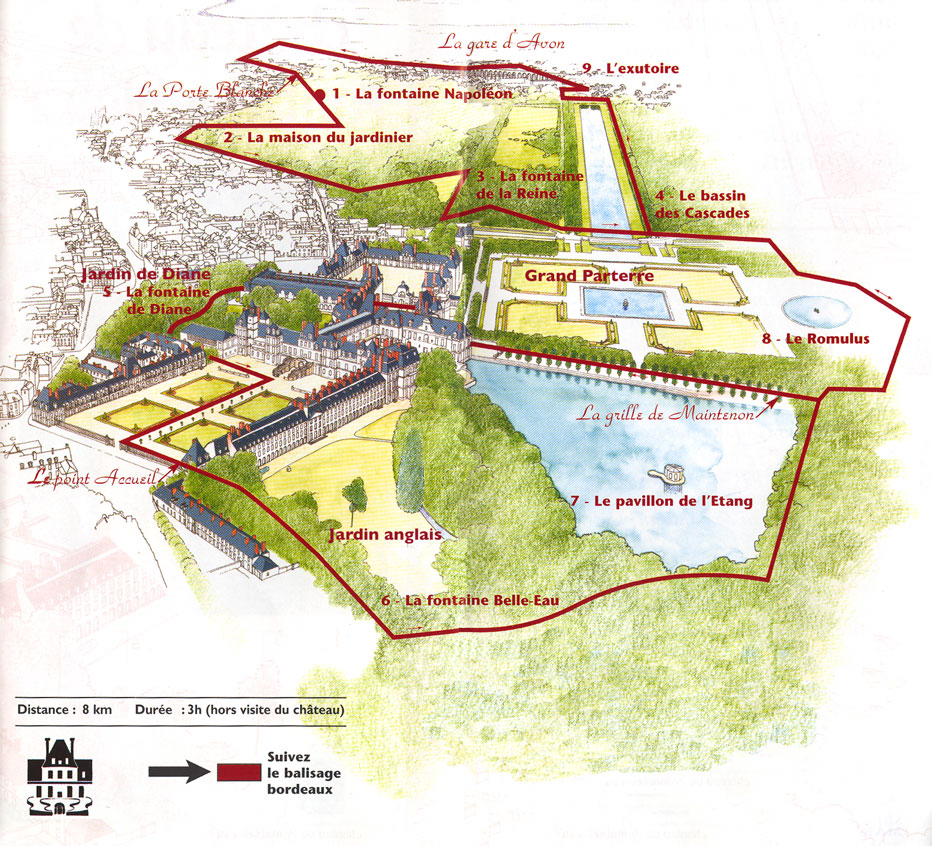
There is a nice printable map of the town of Fontainebleau at http://www.lyceefrancois1.net/IMG/jpg/jpg_Plan-Fontainebleau.jpg. While the name of the Palace is not on the map, the Palace complex of buildings is clearly visible in black on the north side of the Palace Grounds, which include the labeled Jardin Anglais (English Garden).

The streets were lined with buildings of three to six stories, with shops on the ground floor. The town was very tidy.

The trip from the train station to the Palace took about 15 minutes. The bus made several stops along the way. As is the case with most local buses I’ve seen in Europe, the bus only stopped when passengers pressed one of the stop buttons on the bus or when there were people waiting at the bus stops.

The stop near the Palace was across the street from a back entrance to the Palace grounds. That was at the point where Rue Grande becomes Rue Denecourt at the intersection of Rue de France. It is clearly visible on Google Maps street view by typing Rue Denecourt, Fontainebleau, France.

We crossed the street and walked through an open gate onto the grounds of the Palace. No ticket was required to walk through the gate because there is no charge for admission to the Palace grounds.

Château de Fontainebleau

The Palace of Fontainebleau (http://en.wikipedia.org/wiki/Palace_of_Fontainebleau & http://www.musee-chateau-fontainebleau.fr/spip.php?page=sommaire&lang=en) is one of the largest French Royal Châteaux. There has been a Château here since the 13th Century. The current Palace was started by King Francis I in the 16th Century and significantly added to over the years by other monarchs.

The Renaissance was introduced to France through the various Italian artists responsible for the interior wall and ceiling decor. The Palace had fallen into disrepair by the end of the 18th Century, but Napoleon I, who preferred it to Versailles, reinvigorated it.

While it is very nice, in our opinion, it does not compare to Versailles. However, I have read other opinions which claim that it is better than Versailles.

The Palace building complex is very large; however, it is only possible to visit a small part.

The map below, from http://s1.e-monsite.com/2009/05/18/45546376fontainebleau-jpg.jpg, gives some sense of the size of the Palace complex. Also, floor plans of the ground floor and first floor rooms open to visitors are available on the web site: http://www.chateaudefontainebleau.net/plans.php. Click on Rez de Chaussée for the Ground Floor and 1er étage for the First Floor. Vue Globale is for the outside of the Palace and its grounds.


I was surprised to learn from Wikipedia that part of the Palace is currently used as an art, architecture, and music school for students from the U.S. It is called the Ecole d’Arts Americaines (School of American Arts). It was founded by General Pershing during World War I.

The town of Fontainebleau grew up around the Palace and the Forest of Fontainebleau, a former royal hunting ground.

Our Visit

When we passed through the gate near the bus stop, we entered the Garden of Diana (Jardin de Diane), which had lawns and a variety of impressive, tall trees.

As we walked along a path through the garden, we came to a very interesting fountain, which was called Diana’s Fountain (La Fontaine de Diane), and which was built in 1602.  At the top center of the fountain was a bronze statue of the hunting goddess Diana. Her left hand was on the head of a leaping stag. Her right hand was reaching into an arrow quiver on her back. Below her are four large bronze dogs which are peeing water! Below the dogs are the heads of four large stags, with water pouring from their mouths.


 Fountain of Diana

Although the garden was next to one of the large palace buildings, I did not see any signs indicating where to find the entrance. I asked a French woman who was on a field trip with a group of students. She explained how to get to the entrance.

We walked through a passage between two buildings and emerged into the Place du General de Gaulle, a huge courtyard surrounded on three sides by Palace buildings. 
 Center Palace Building from Place du General de Gaulle

As we came into the courtyard, we saw two firemen near a fire truck. One of them was completely covered with a mask over his face and hood over his head. He was climbing up a step ladder. It turned out that he was removing a bees’ nest or hornets’ nest from an outside wall.

After enjoying an impressive view of the buildings around the courtyard, we entered the building on the right as we faced the center building. The area we entered was the visitors’ entrance. Although I had the Museum Pass, I still had to go to the ticket window to pick up free tickets for the three of us. That just took a minute because there was no one else in line. In fact, there were not many visitors at the Palace, in contrast to the hordes at Versailles.

There were two groups in the entrance hall when we arrived - an adult tour group and a group of small children. The children seemed much too young to appreciate a place like the Palace.

We walked down a long hall. At the end of the hall, we showed our tickets and then walked up a stairway to the first floor (second floor in the U.S.).

The first room at the top of the stairs was a Napoleonic Museum, which we did not visit. We turned to the right and entered the Gallery of Splendors (Galerie des Fastes). It had paintings depicting court life at the Palace. There was also a very large tapestry on temporary display. It was a “cartoon”(carton)  tapestry called the Triumph of Venus (http://www.metmuseum.org/special/tapestry/view_alt.asp?item=19). It was designed by Noël Coypel during the period 1690-1693. It was produced in the royal tapestry factory called the Manufacture des Gobelins in Paris.
Triumph of Venus

Next, we went into the Gallery of Plates (Galerie des Assiettes), a long narrow room with wooden walls. There were 128 Sèvres china plates set into the walls. They illustrate the history of the Palace. Along the top of the walls and on the ceiling were a number of paintings from the early 17th Century.
Gallery of Plates

At the other end of the gallery was a vestibule called the Horseshoe Vestibule (Vestibule du Fer à Cheval). From this vestibule, we would continue straight ahead to visit a set of rooms in one wing of the palace, and then return to the vestibule to continue into another wing.

We went straight ahead to a set of rooms that was known by two names:
1. Apartment of the Pope. The rooms were given this name because Pope Pius VII stayed there twice. In 1804, he came to consecrate Napoleon as emperor. From 1812 until 1814, Napoleon kept the pope there as a prisoner.
2. Apartment of the Queen Mothers. The rooms were given that name for obvious reasons.

The Apartment had been closed to the public for about 20 years. However, it reopened in 2007 after the French company Credit Agricole sponsored renovation of the Apartment.

The Apartment had 12 rooms. We visited the entire apartment, including:
1. A Reception Room. It had several large tapestries, including one entitled “Summer, Sacrifice to Ceres,” which was designed by Pierre Mignard at the end of the 17th Century, and made at the Manufacture des Gobelins.
Summer. Sacrifice to Ceres
2. The Pope’s Bedroom, which was decorated in red and had a chandelier.
3. The Bedroom of the Queen Mother, which had large paintings on the walls, a canopied bed, and a chandelier.
Queen Mother's Bedroom
4. The Great Room (Gros Salon), whose walls were adorned with large tapestries depicting the life of Alexander the Great. It had an ornate ceiling and a chandelier.
5. The Antechamber of the Queen Mother. The walls were covered with beautiful tapestries. The ceiling had beautiful gold-colored wood panels, including seven that represented planets. The mantle of the marble fireplace had a beautiful clock and two very nice vases. Behind the mantle was a very tall mirror.

Then we looked into Trinity Chapel, one of several in the Palace. Our view was from the rear of the upper level. It was very ornate and had a beautiful, painted, barrel-vaulted ceiling.
Trinity Chapel 
From there, we returned to the Horseshoe Vestibule and entered the Gallery of Francis I. This splendid gallery is named after the king responsible for the creation of the current Palace building. It is about 197 feet long and 20 feet wide. Its beautiful frescoes framed in stucco were completed in the early 16th Century. The frescoes and paintings depict scenes from Greco-Roman mythology. The king’s monogram is in wood on the wood paneled wall. This was the first decorated great gallery built in France.
 Gallery of Francis I
In the Gallery of Francis I

Next, we went through the Guards Room (Salle des Gardes). This room was used by the King’s Guards in the 17th and 18th Centuries, but was converted into an antechamber for Napoleon I. In one part of the room was a huge, beautiful Sèvres porcelain vase made in 1832 in a Renaissance style. There was also a huge marble fireplace decorated with a bust of Henri IV.
Sèvres Vase

Then we passed by the Stairway of the King (Escalier du Roi). This area had previously been a room. A stairway was constructed in 1748-49. On the walls are impressive paintings in which Francis I is depicted as Alexander the Great in scenes from the life of Alexander the great.
 At the Stairway of the King
At this point, we missed a turn toward several important rooms - the Apartment of Madame de Maintenon, the Ballroom, and the Chapel of Saint Saturnin.

We now looked out one of the windows and saw a very large courtyard, called the Oval Court (Cour Oval), which was surrounded by three wings of the Palace.

We then went through the First Room of Saint Louis (Première Salle Saint Louis), also known as the Buffet Room (Salle du Buffet). Saint Louis is King Louis IX, the only canonized king of France. St. Louis, Missouri is named after him.

From there, we entered the Second Room of Saint Louis (Deuxième Salle Saint Louis), also known as the Salon du Donjon (The Keep Room - as in a castle keep). This room had a beautiful marble fireplace above which was a huge white bas relief of Henry IV on horseback.

We continued on through the Louis XIII Living Room (Salon Louis XIII), the Francis I Living Room (Salon Francis I), the Tapestries Living Room (Salon des Tapisseries), and the Antechamber of the Empress (Antichambre de l’Impératrice)

Next, we saw the Gallery of Diana or Diane (Galerie de Diane). Henry IV built it for his wife, Diane de Poitiers. Napoleon I converted it into a library, which currently has some 16,000 books.  The room is 262 feet long and 23 feet wide. It has a beautiful, painted, barrel-vaulted ceiling.
 Gallery of Diana
 We then walked through the uninteresting White Living Room (Salon Blanc) and through the Games Room of the Queen (Salon des Jeux de la Reine) also called the Great Room of the Empress (Grand Salon de l’Impératrice).

Next we entered the Bedroom of the Empress (Chambre de l’Impératrice), a very nice room that was decorated in green and white. It had an elaborate canopied bed that probably had the nicest of all the bed canopies in the Palace.
Bedroom of the Empress 
From there, we passed through the Queen’s Boudoir (Boudoir de la Reine) into the Throne Room (Salle du Trône). This room seemed appropriately regal. A blue and gold throne sat on a red dais under a blue and red canopy. It had an elaborate gold and white ceiling. There was a large portrait of Louis XIII above the fireplace.
Throne Room

Next was the Salle du Conseil (Council Chamber), which was very nicely decorated with painted panels. On the panels were allegorical figures representing Earth, War, Valor, Force, Justice, Peace, Secrecy, Prudence, the four seasons, etc., etc. The ceiling was also painted. There were four chandeliers.

From there, we went into the Emperor’s Bedroom (Chambre de l’Empereur). It had the usual canopied bed. The top of the canopy was gold and the drapes on the side were green. The bed was relatively short. The bed was high enough off the ground that there was a step stool next to it so the Emperor could climb into it. There was a chandelier, and the walls were covered with white, gold, and blue panels.
 Emperor's Bedroom
The room after that was the Emperor’s small Bedroom (Petite Chambre à Coucher de l’Empereur). It had a much simpler and narrower canopied bed. Napoleon used it as a study and as a second bedroom.

Emperor’s Private Room - called the Abdication Room (Salle Particulier de l’Empereur dit Salon de l’Abdication). It was in that room that in April 1814, Napoleon I signed an agreement agreeing to abdicate his rule. He was then exiled to Elba. However, he escaped from Elba in February of 1815 and tried to regain power and defeat his enemies. However, he was soundly defeated at Waterloo and exiled to Saint Helena, a remote, British-controlled island in the South Atlantic.

We then went through a few more rooms - the Emperor’s Bathroom (Passage des Bains et Salle de Bains de l’Empereur), the Room of the Emperor’s Aides de Camp (Salon des Aides de Camp de l’Empereur), and the
Emperor’s Antechamber (Antichambre de l’Empereur).

We then walked down to the ground floor and exited the palace into the Place de General de Gaulle. It was now about 4 pm. We were all hungry and decided to look for a place to eat. Instead of leaving the way we had arrived - through the Garden of Diana - we walked straight out of the front gate to see if we could find a nearby restaurant that appealed to us. We walked out of the front gate and turned right onto Boulevard Magenta.

We walked to the first street, Rue Dénecourt and turned right. We walked along a wall on one side of the Palace wall. At that point, I decided to see if I could find Bistrot 9, a restaurant about which I had read good reviews on the Internet.  We continued past the bus stop where we had arrived at the Palace. One block past the bus stop, we came to Rue Montebello and turned right. We quickly found the restaurant, but discovered that it was closed. There was at least one other restaurant there, but it did not appeal to us.

We returned to the area near the bus stop, where we found a restaurant that looked good. It was Le Delice Imperial, at the intersection of Rue Dénecourt, Rue de France, and Rue Grande. It was across the street from a carousel. It had outdoor and indoor tables. We decided to eat inside because it appeared ready to rain.

My grandchildren each had a Crêpe Complète - a buckwheat crêpe (known as a galette) with egg, ham, and cheese - for €8.50 each. They shared an order of French fries for €4. My grandson had a Fanta for €3.50 and my granddaughter had an Orangina for the same price. For dessert, My granddaughter had a crêpe filled with strawberries for €4.

I had duck foie gras with fig jam and toast (Bloc de Foie Gras de Canard avec Confiture de Figues et ses Toasts) for €10. I also had warm goat cheese with herbes de Provence on toast and salad with olive oil (Le Duo de Chèvre Chaud aux Herbes de Provence sur Toasts et sa Salade à l’Huile d’Olive) for €8. Both dishes were very tasty. I also had a small 25 cl carafe of Alsatian Gewürztraminer for €5.50, and water. 

The total cost of the meal was €55.50 ($79.92).

Our waiter was a very nice young man named David. We chatted about a variety of subjects. We compared the weather in Fontainebleau to that of Florida, chatted about travel, etc. The cashier was also very pleasant.

It rained while we were inside the restaurant, but had stopped by the time we went to catch the bus.

We left the restaurant at about 5:15 and hurried across the street to the bus stop because we saw a bus coming. In my hurry, I forgot my hat at the restaurant.

At the train station, we had to wait about 25 minutes for a train. The train, which was blue and white, and had two levels, left Fontainebleau at 6:04 pm, and arrived at Gare de Lyon, Paris at 6:41 pm.
Fontainebleau-Avon Station

From the Gare de Lyon, we set out for Gare d’Austerlitz on the other side of the Seine. Since it was threatening to rain, I decided to walk through a building across Rue de Bercy from the train station. We walked across a covered elevated walkway above Rue de Bercy and entered the first floor (U.S. second floor) of the building. At the other end of the building, we found an elevator down to the ground floor and exited onto Rue Van Gogh, where we turned left. We walked about half a block to a traffic light at Quai de la Rapée and crossed Rue Van Gogh. Then we turned left and walked across the Seine via Pont Charles de Gaulle to the Gare d’Austerlitz.

We then took the Line 10 subway two stops to Cardinal Lemoine station. On leaving the station, we walked a few feet to the Carrefour supermarket. There, I purchased a pack of 15 packets of tissues for €4.81. (European tissues, at least in France, Spain, and Italy, are larger and much stronger than U.S. tissues.)

We then returned to our apartment, arriving about 8 pm.

Friday, July 29, 2011

Dinner at Les Deux Magots, Saint Germain des Prés

On the evening of our visit to the Louvre and Montparnasse, we decided to have dinner at Les Deux Magots, a famous café in the Saint Germain des Prés area.


We left our apartment after 9 pm, and went to the Cardinal Lemoine Metro station, from which we took Line 10 to Mabillon - five stops in the direction of Boulogne.

We came up out of the station onto Rue du Four, and walked a short block to Boulevard Saint Germain. There we turned left and walked about three blocks to the café. On the way, we passed the typical 5-6 story Pqris buildings with shops on the ground floor and apartments above. We also passed the historic church (aren’t they all?) of Saint Germain des Prés.

The café was on the northwest corner of the intersection of Boulevard Saint Germain des Prés and Rue Bonaparte. We were quickly seated at a table in a glass-enclosed terrace.
Les Deux Magots
Area where we were seated

Les Deux Magots (http://www.lesdeuxmagots.fr/index.php and http://en.wikipedia.org/wiki/Les_Deux_Magots) was once a rendez-vous for the literary and intellectual elite such as Jean-Paul Sartre, Simone de Beauvois, Albert Camus, and Pablo Picasso, and young writers like Ernest Hemingway. Every year since 1933, it has awarded a literary prize for a French novel.

The business was originally a silk shop and took its name from a popular play, Les Deux Magots de la Chine (The Two Figurines from China). It moved to its current location in 1873 and became a café in 1884. In 1972, the terrorist Carlos the Jackal carried out a grenade attack against the café; killing 2 and injuring 34.

The Chinese Figurines
When we visited Paris in 2006, we had dined at Café de Flore on the next block.

When I had originally checked the café’s menu at its web site, I had seen that it included a selection of sandwiches that I thought would be acceptable to my grandchildren. I had not realized that those sandwiches were not served at the peak of the dinner hour - between 9 pm and 1130 pm. The web site has a separate dinner menu.

My grandchildren both chose the same dish - penne pasta with basil and tomato for €16 each. One of them had an Orangina for €6.20 and the other had a coke for the same price.

My meal was very nice. I started with layered tomato and fresh goat cheese (Millefeuille de Tomates et Chèvres Frais) for €13. Then I had roast rack of lamb with herbs and homemade purée (Carré d’Agneau Rôti aux Herbes,  Purée Maison) for €30. For wine, I had two 18 cl glasses of Saumur Champigny for €7 each. The food was superb and the wine very nice.
 My Millefeuille de Tomates
The total price came to €98.40 ($141.70). Our waiter was efficient, but cold, unlike some of the very nice waiters who had served us. We left the restaurant about 11 :30 pm, and returned to our neighborhood using the route by which we had come.

Instead of turning onto Rue Rollin toward our apartment, we crossed Place de la Contrescarpe and walked to Alberto’s gelato shop on Rue Mouffetard. My granddaughter had a cone with After Eight Mint and Chocolate, and my grandson had a cup of After Eight. I had a cone of Cinnamon and Tart Lemon (Cannelles & Tarte Citron). Delicious as usual.

We arrived back at the apartment some time after midnight.

Montparnasse and the Montparnasse Tower

After visiting the Louvre and walking through Little Tokyo on June 16th, we set out to visit the Montparnasse Tower, the only skyscraper inside Paris.
 Montparnasse Tower (and the Eglise du Dome)
Montparnasse (http://en.wikipedia.org/wiki/Montparnasse) is a section of Paris located in the 14th Arrondissement on the south side of Paris. Its name is derived from the Greek Mount Parnassus. It was given the name by French students who used to go to the hill there to recite poetry. The hill was leveled in the 18th Century to build the Boulevard Montparnasse. Many cabarets and dance halls opened there during the French Revolution.

At the beginning of the 20th Century, it was the heart of intellectual and artistic life in Paris. It was frequented and inhabited by artists and writers like Picasso, Dali, Modigliani, Hemingway, Marc Chagall, Ezra Pound, James Joyce, etc., etc., etc., etc.

I have never explored the Montparnasse area, but would love to do that some day.

The full name of the Tour Montparnasse (Montparnasse Tower) is the Tour Maine-Montparnasse (Maine-Montparnasse Tower (http://en.wikipedia.org/wiki/Tour_Montparnasse) and (http://www.tourmontparnasse56.com/index_EN.php#/home). It was completed in 1972 and was the tallest building in France from then until 2011. It has 58 stories and is 689 in height. 

The views from the top are terrific. You can see all the major monuments of Paris (except the tower, of course). The 56th floor is a viewing floor. It is surrounded by large glass windows. It contains a bar, souvenir shop, and restrooms. There is an open-air viewing terrace and helipad at the very top. The viewing radius is about 25 miles.

It is the only skyscraper within Paris. Its architecture has been criticized as being out of place with the landscape of Paris. The construction of new skyscrapers inside Paris has now been banned.

In 1995, French urban climber, Alain “Spiderman” climbed to the top using only his bare hands and feet, and no safety devices. He nearly fell off on the way up.

The normal admission rates for the 56th floor and the 59th floor terrace are:
Adults - €11.50
Youths- 6-20 - €8.50
Children - 7-15 -€4.70
Children under 7 - free.

We paid lower rates because the 59th floor was closed for maintenance. My ticket cost €10, and my grandchildren’s were €4.20 each.

We walked up to the tower and immediately saw the tourist entrance as described on the Internet. On one side of the building, there is a covered set of steps. On the first cover are the words, “Tout Paris à 360⁰ (All of Paris at 360 degrees).
Tower Entrance

We walked up the stairs and entered the building. Unfortunately, a group of about 40 Chinese tourists arrived just ahead of us. We had to wait until their guide had gone through the mechanics of getting their tickets. After we purchased our tickets, we had to wait until they had gone up the elevator.

The elevator to the top is very fast. According to the tower web site above, it takes 38 seconds to reach the top.

As we got off the elevator at the top, a man working there asked if we wanted our photo taken. When I refused, he made a sarcastic remark. I assume he was trying to sell the photos.

The 56th floor was large and uncrowded. We walked around, enjoying fantastic views of the Eiffel Tower, the Arc de Triomphe, the Eglise du Dome, Sacre Coeur, Place de la Concorde, the Basilique Sainte Clotilde, the Latin Quarter, the Louvre, Pont Alexandre III, the Grand Palais, Saint Germain des Pres, Eglise Saint Sulpice, and Notre Dame Cathedral.
Eiffel Tower
Skyscrapers in background are in La Defense, outside Paris. Wooded area between La Defense and Eiffel Tower is the Bois de Boulogne Park. Long park in front of the Eiffel Tower is the Champ de Mars. Building at the front of the Champ de Mars is the Ecole Militaire, officers' school which Napoleon attended.

Eglise du Dome, Site of Napoleon's Tomb
Cathedral of Notre Dame

After enjoying the views, we sat down and had a drink. My granddaughter had a Coke Zero (Coca Zero) 50 cl for €3.80, My grandson had a Fanta Orange 50 cl for the same price, and I had two drinks - a Kir Royal Coupe (crème de cassis and champagne) for €8.50 and Perrier 50 cl for €3.30.

After looking around a bit more, checking out the souvenir shop, and using the rest rooms, we took the elevator back down to the entrance. We left the building about 7:40 pm.
We walked back into the train and Metro station to Line 12. We took Line 12 to Sèvres-Babylone - three stops in the direction of Porte de la Chapelle. We then took Line 10 to Cardinal Lemoine - five stops in the direction of Gare d’Austerlitz.

We walked out of the station and walked a few feet to the Carrefour supermarket, where we purchased a 375 gram box Kellogg’s Frosted Flakes (which are called Kellogg’s Frosties in France) for €2.64 for breakfast for my grandson.

Then we returned to our apartment, where we arrived at about 8:30 pm.