Showing posts with label Sonoma Wineries. Show all posts

Monday, January 2, 2012

Napa and Sonoma Winery Impressions

During our October visit to California, we visited 23 Sonoma and Napa wineries, at which we tasted 127 wines. We tasted another 15 wines at restaurants and private homes. Since we primarily drink red wines, we only tried a few whites. In general, the wines we had were very nice to excellent. There were only a few that we did not like. One of the unique pleasures of the Sonoma and Napa wineries was the terrific Zinfandels. Despite the fact that we prefer reds, one great tasting experience we had was the 1991 Chateau Montelena Chardonnay, made in the style of its predecessor that won the 1976 Paris tasting.

A Beautiful Old Sonoma Vine

Another great experience during our winery visits was seeing the great Mike Grgich, whose splendid wine open the eyes of the world to the quality of California wines.

Mike Grgich

One important lesson I learned in Napa and Sonoma is how many different microclimates there are in that small region, and how strong a role those microclimates play in the production of the local wines.

California Wineries vs. European Wineries

Over the course of the past 10 years, we have visited 33 wineries in California and 30 in Europe - 17 in France, 10 in Italy, 2 Greece, and 1 in Spain.The winery in Spain was a very commercial sherry winery (Gonzalez-Byass), so I would put that in a different category than the others.

While the wines in California and Europe are comparable in quality, I have noticed some differences between the tasting rooms of the wineries in the two continents. California winery tasting rooms seem to be far more commercial than the European wineries. However, there were several European wineries that were similar to the California wineries in that regard.

One aspect of the commercial focus of the California wineries was the fee for tasting wines. In general, the European wineries were less expensive or free. There were a couple of exceptions - Chateau Mouton Rothschild in France, and Antinori and Castello di Brolio in Italy.

Another difference that I experienced was responsiveness to emails. All of the European wineries to which I have sent emails have responded. None of the California wineries responded to my emails, even when I explained that I was searching for wines to use at a tasting for our wine club. I chose wineries that had interesting historic backgrounds and explained why I was interested in them. I referred them to the Tuscan Wines page of my blog as an example of the type of presentation I do. Nonetheless, there was no response.

Sonoma vs. Napa

We also noticed that Sonoma winery tasting rooms tended to be more friendly and less commercial than their Napa counterparts. However, there were some in Napa that were very friendly - particularly Charles Krug, Louis M. Martini, Grgich Hills, and Chateau Montelena. The cost of tastings was generally more expensive in Napa than Sonoma.

Discounted and Free Tastings

We discovered that there were a number of ways one could obtain discounted or free tastings:
1. Internet coupons. Many wineries have wine tasting coupons on their web sites.
2. Credit-card discounts. Bearers of Visa Signature credit cards were entitled to free tastings at some wineries.
3. Hotel-provided coupons for wineries. Some Napa and Sonoma hotels and inns offer their guests coupons for free or discounted tastings at nearby wineries.
4. Recommendations from other wineries. Some winery tasting rooms offer visitors coupons to visit other nearby wineries. In one case, we were giving a free tasting because we told the pourer that we had been sent to the winery by an individual at another winery.
5. Residential Discounts. Some wineries offer discounts or free tastings to area residents and sometimes to their guests.

Wine Clubs

All of the wineries we visited had wine clubs that offered significant discounts to members - typically 20%. However, shipping costs have to be added to the bottle cost. A little research indicates to me that the least expensive option is to purchase the same wine at my local wine store, if available, rather than directly from the winery. Some wineries are so small that all their wines are sold from the winery. In other cases, some larger wineries produce certain special wines in such small quantities that they are only available by direct purchase from the winery.

Tuesday, December 20, 2011

Kunde Family Estate - Nice Whites, Unimpressive Reds

After visiting the B.R. Cohn winery with our Sonoma hosts in October, we drove 5 miles north down Sonoma Highway to the Kunde Family Estate (http://www.kunde.com/welcome), the last of 13 wineries we visited in Sonoma County, prior to heading to the Napa Valley.

Kunde is another example of a winery that has been in the same family for a long time. The estate was established in 1904 by Louis Kunde, a German immigrant who purchased Wildwood Vineyards. In 1977, the Kundes expanded their property by purchasing the neighboring 850-acre Kinneybrook Ranch. The estate is now operated by the 4th and 5th generations of the family.

In 1879, 25 years prior to being purchased by Kunde, vineyards were first established on the property with cuttings from Chateau Margaux and Chateau Lafite Rothschild, both of whose wines are classified as Premier Grand Cru wines. They are both in the Médoc area  of the Gironde Department of France, where Bordeaux wines are produced.

The tasting room was very pleasant and the woman who served us was very helpful and informative. Just outside the tasting room is a a pretty pond with three fountains. There is a patio with tables and chairs overlooking the pond.

 Pond Outside the Tasting Room

The Kunde wine tasting menu had seven wines - three whites and four reds. The normal tasting fee is $10. However, we were not charged because we had Visa Signature credit cards. We tried two of the white wines and three of the reds. The whites were very nice, but the reds were unimpressive. We were served Kunde Sea Salt Chocolates with the last red. They were fantastic. The prices below are without the wine club discount:
- 2010 Magnolia Lane Sauvignon Blanc - very nice - $15
- 2010 Gewurtztraminer - very nice - $15
- 2007 Zinfandel - nice - $18
- 2007 Merlot - decent - $24
- 2007 Dunfillan Cuvée, 52% Syrah, 48% Cabernet Sauvignon - drinkable - $35

Just prior to our trip to California, we'd tried a Kunde Chardonnay at a wine club dinner. It was very nice like the two whites we tried at the Kunde tasting room. My wife and I are not normally fond of whites, so it's interesting to me that we like all three of their whites that we've tried, and would not buy any of their reds after our tasting at the winery.

B.R. Cohn Winery, Sonoma - Rockin' Round the Vines

One of the interesting and high-quality wineries we visited during our October trip to California was the B.R. Cohn Winery (http://en.wikipedia.org/wiki/B._R._Cohn_Winery & http://www.brcohn.com/) on Route 12 in Glen Ellen in the heart of the Sonoma Valley. It was founded in 1984 by Bruce Cohn, manager of the Doobie Brothers rock band. Cohn grew up in Sonoma County. He purchased the winery property in 1974 and named it Olive Hill Estate Vineyards, after a 145-year-old grove of Picholine olive trees on the property.

For the first 10 years that Cohn owned the estate, he raised grapes and sold them to other wineries, starting with Sebastiani, and then Ravenswood and Gundlach-Bundschu - all three of which we coincidentally visited on the same day and in the same sequence just prior to coming to B.R. Cohn.

The vineyards around the winery are primarily planted in Cabernet Sauvignon vines.

The winery also produces olive oils from its olives and vinegars from its wines.

Cohn lives on the estate, from which he manages the Doobie Brothers and the winery’s operations.

For the past quarter century, the winery has hosted an annual charity music festival in the fall.

The tasting room is in a nice, white, wooden, two-story building. Next door is a gourmet shop that sells Cohn’s olive oils and other foods. In front of the winery, were several funky car sculptures.

The Tasting Room

Funky Car Sculpture

Another Car Sculpture


The Gourmet Shop

The two wine-tasting lists contained a total of 24 wines, of which 18 were reds, 4 were whites, and 2 were dessert wines. One of the two lists was the “Classic Car Wines” tasting menu - with wines like Drag Racer Red, Panel Wagon Pinot, and Boater’s Barbera.

We tried four wines, of which three were excellent and one was very nice. We were not charged for the tasting. I have listed below with each wine both the retail and the club price per bottle:
- 2009 Silver Label Cabernet Sauvignon, 76.6% Cabernet Sauvignon, 13.9% Merlot, 9.5% Cabernet Franc - very nice - $20/$16
- 2009 Mendocino County Barbera - excellent - $35/$28
- 2008 Olive Hill Estate Cabernet Sauvignon - excellent - $55/$44
- Non-vintage Boater’s Barbera - excellent - $22/$11. This wine is named in honor of Cohn’s 1963 Century Resorter mahogany ski boat. Only 300 cases of this wine are produced.

Monday, December 19, 2011

Gundlach-Bundschu Winery - One of California's Oldest

One of the oldest of the 23 wineries we visited during our October trip to California was Gundlach-Bundschu, which is located on the east side of the town of Sonoma, below hills of the Mayacamas Range, which separates the Sonoma and Napa Valleys.

Gundlach-Bundschu Winery (http://www.gunbun.com/) is over 150 years old. It is probably California’s oldest family-owned winery, and is currently operated by the sixth generation of the family. Its roots are in Bavaria. The property was purchased by in 1858 by Jacob Gundlach, a Bavarian immigrant whose father was a winemaker in Bavaria. He called his new property, “Rhinefarm.”

After purchasing the property, he returned to Bavaria and got married. Then he and his new wife traveled through Germany and France, where they purchased rootstock to plant on Rhinefarm.

Charles Bundschu, an immigrant from Mannheim, Germany, joined the winery in 1868. He later married Jacob Gundlach’s oldest daughter. Bundschu took over management of the winery after Gundlach retired. When Gundlach passed away, the winery became Gundlach-Bundschu.

The winery was devastated by the 1906 San Francisco earthquake. At that time, the grapes were grown at Rhinefarm, but the winery was a block-long building in San Francisco. The fire resulting from the earthquake destroyed the winery, a million gallons of wine, and three of the family’s homes. The family began rebuilding their business from the Sonoma property.

Prohibition was also devastating to the family. They had to liquidate all but 130 acres of Rhinefarm. The winery was not reborn until 1973, and its first wines released in 1976. In that same year, it became one of the first California wineries to produce a varietal Merlot wine.

Over the years, the family reacquired much of the Rhinefarm property it had been forced to sell.

Gundlach-Bundschu Tasting Room

Another Part of the Tasting Room

The winery offers a tasting of six wines for $10. There are 12 wines on its tasting list. All but two are reds. The six wines we sampled ranged in taste from excellent to drinkable. I have listed below with each wine both the retail and the wine club price per bottle:
- 2009 Pinot Noir - drinkable - $34/$27.50
- 2008 Mountain Cuvée, 37% Cabernet Sauvignon, 29% Merlot, 12% Cabernet Franc, 10% Petit Verdot, 7% Malbec, 5% Syrah  - nice - $24/$19.20
- 2008 Merlot - nice - $30/$24
- 2009 Tempranillo - very nice - $37/$29.60
- 2008 Cabernet Sauvignon - very nice - $40/$32
- 2008 Vintage Reserve Cabernet Sauvignon, 94% Cabernet Sauvignon, 3% Petit Verdot, 3% Cabernet Franc - excellent - $80/$64

The winery offers interesting-sounding tours of its vineyards and caves. The cave tour includes a barrel tasting.

Like many of the Sonoma and Napa wineries, Gundlach-Bundschu has facilities to cater to special events such as weddings. Its facilities include a cave dining room, a bungalow, a picnic arbor, a winery courtyard, and an outdoor amphitheater which can seat up to 500 people.

Saturday, December 17, 2011

Ravenswood Winery, Sonoma - Loved It

We had a very nice tasting at the Ravenswood Winery (http://www.ravenswoodwinery.com/#), which is famous for its Zinfandels. It is located on  Gehricke Rd., on the northeast side of the town of Sonoma. This tasting was one of the nicest because of the wide range of Zinfandels and the pleasant interaction we had with the tasting room manager.

Ravenswood was started in 1976 by Joel Peterson, a microbiologist at Sonoma Valley Hospital. Winemaking was his passion and the hospital employment provided an income. His winemaking locations changed five times before he permanently established the winery at its current location in 1991.

His passion has been Zinfandels, and Ravenswood produces an amazing variety of them. Their tasting list had 14 Zinfandels from 9 appellations in 5 counties.

In 2001, Peterson sold Ravenswood to the huge firm - Constellation Brands. However, he stayed on as head winemaker. He now focuses on Ravenswood’s single-vineyard zinfandels.

Peterson picked the name of the winery for two reasons:
1. In 1976, when he was picking grapes for his first wines, a thunderstorm was threatening. As he was rushing to get the grapes picked for the first time, three ravens watched over him.
2. He was an opera buff and the character Lord Ravenswood from a Donizetti opera reminded Peterson of his new winemaking experience. In the opera, Lord Ravenswood sinks to his death in quicksand. Peterson felt he was going through a similar experience as a new winemaker.

In February of this year, he was inducted into the Vintner Hall of Fame. For a video interview with him and a tasting with him, see:

The winery logo features three ravens in a circle. The winery’s motto is “No Wimpy Wines!”

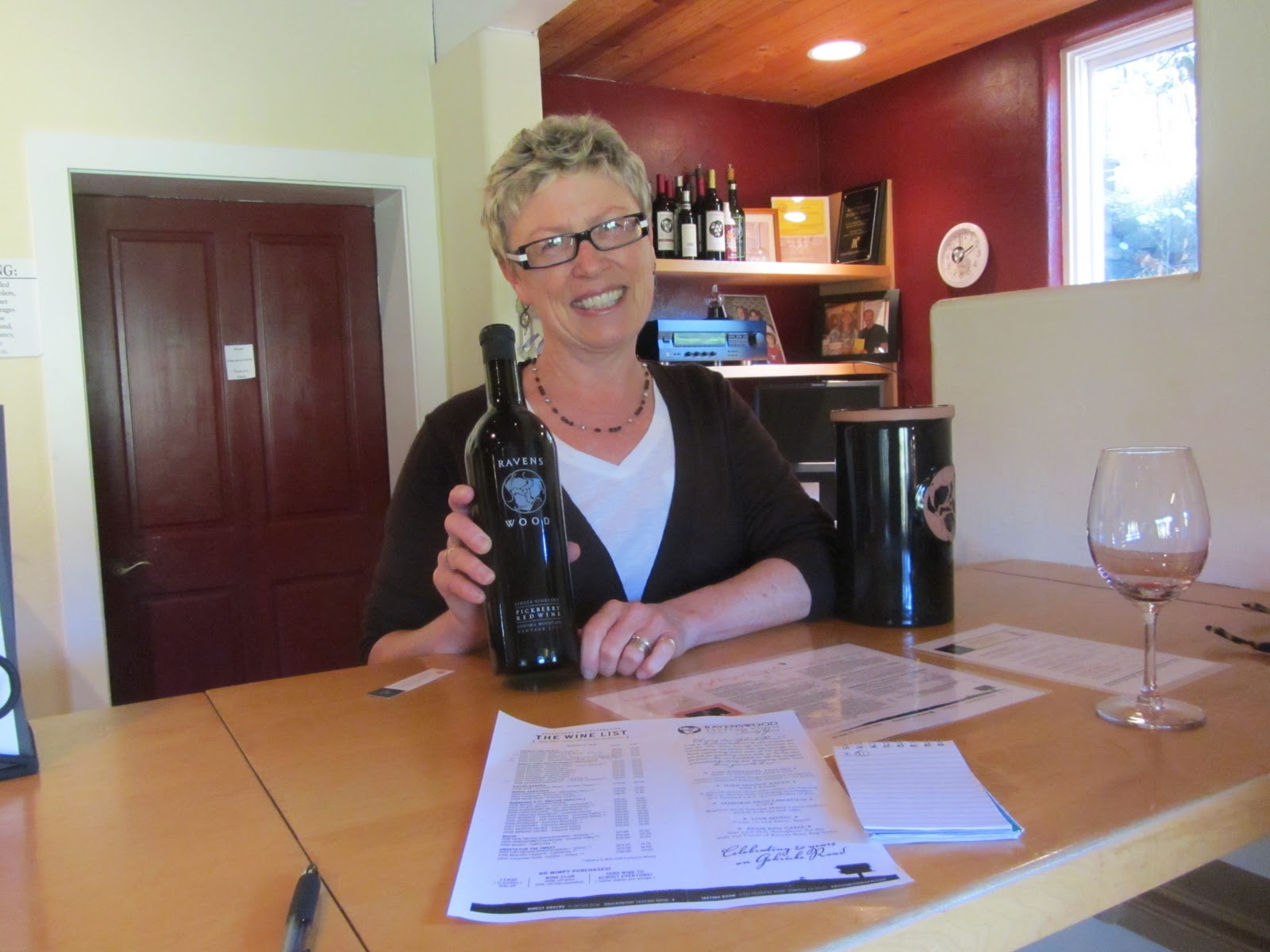
The tasting room, which is open 10 am to 4:30 pm, was decorated in light colors and was very pleasant. When we stepped up to the tasting bar, we were served by Kristin Wastell, the manager of the visitor center. She was very knowledgeable, upbeat, and helpful. She was one of the nicest people we met at the 23 wineries we visited.
The tasting room offers two types of tastings:
1. $10 for their County wines
2. $15 for their Vineyard Designate wines

The Tasting Room

Kristin

We tasted seven red wines, of which six were Zins. They ranged in taste from excellent to nice. I have listed below with each wine both the retail and the club price per bottle:
County Zinfandels
- 2009 Lodi Old Vine Zinfandel, 77% Zinfandel, 23% Petite Sirah - nice - $15/$12. The microclimate of Lodi, in the Central Valley east of Sonoma and Napa, is ideal for Zinfandel, with its hot days and cool nights.
- 2009 Napa Valley Old Vine Zinfandel, 76% Zinfandel, 24% Petite Sirah - very nice - $15/$12
-2008 Sonoma County Old Vine Zinfandel, 77% Zinfandel, 10% Petite Sirah, 8% Syrah, 5% Carignane - very nice -$18.50/$14.80
Single Vineyard Zinfandels
- 2009 Alexander Valley Big River Zinfandel, 100% Zinfandel - Excellent - $35/$28
- 2009 Dry Creek Valley Teldeschi Zinfandel, 75% Zinfandel, 20% Petite Sirah, 3% Carignane, 2% Alicante Bouschet - very nice - $35/$28
Bordeaux & St. Emilion Varietals
- 2007 Sonoma Mountain Pickberry, 58% Merlot, 42% Cabernet Sauvignon - Excellent - $50/$40
Dessert Wines
- 2009 Zinfandel Suite, half bottle - excellent - $30/$24 (Only 1.5 barrels of this wine were produced.)

Kristin described Ravenswood founder and current winemaker Joel Peterson as “beloved.” From everything I have read about him, he sounds like a nice, one-of-a-kind individual.

Kristin said that Ravenswood’s “Old Vine” wines are from vines that are 45 to 100 years old. She also mentioned than Zinfandel grapes ripen earlier than others because they have thin skins.

After leaving Ravenswood, we stopped a short distance away on Gehricke Rd. where I took pictures of some great old vines with thick trunks.
An Old Vine on Gehricke Road

Friday, December 16, 2011

A Tasting at Sonoma's Historic Sebastiani Winery

One of the wineries we visited during our Sonoma visit was the historic Sebastiani Vineyards and Winery(http://www.sebastiani.com/), which is located on 4th St. East on the east side of the town of Sonoma, a short distance from Sonoma Plaza.

The winery was established in 1904 by Samuele Sebastiani, who immigrated from Tuscany in 1897. He originally worked as a stone mason, who quarried cobblestone from the hills around Sonoma and used it to help pave the streets of San Francisco. He used his earnings from the stone trade to buy the vineyards planted in Sonoma at the San Francisco de Solano Catholic Mission in 1825.

After Samuele died in 1944, his son August, and August’s wife Sylvia, took over the winery. Under August, the winery dramatically increased its production. After August’s death, his wife, his sons Don and Sam, and his daughter Mary Ann operated the winery. Sam was removed from running the company by his mother in 1986. He and his wife Vicki subsequently started Viansa Winery, which I described in another posting.

Our Sonoma host, who knew Sam and who had been assigned to the nearby Skaggs Island naval station told me that Sam loved the Navy and was really nice to the sailors from that base.

Don dramatically increased the company’s production through mass-market brands and wine production in California’s Central Valley. Production increased to 8 million cases per year. In 2001, the company sold its mass market operations to Constellation Brands, and returned its focus to its Sebastiani winemaking in Sonoma. Don then departed to start a winery. Mary Ann ran Sebastiani until it was sold to Bill Foley in 2008. Foley owns 13 wineries.

Sebastiani's tasting room was very nice, with the usual shop selling accessories, clothing, etc. Off of the main tasting room was a beautiful private tasting room.
Tasting Room

 Private Tasting Room

We were served by a gentleman named Pat. There were two types of tastings available - one for $10 and one for $15. My wife and I shared a $10 tasting. The $10 tasting list had seven wines, as did the $15 list.
Pat

When I explained to Pat that I was doing research for a tasting and presentation for our wine club, and that we were primarily interested in red wines, he kindly let us substitute a couple of the reds on the $15 list for the whites on the $10 list.

We tasted six red wines ranging in quality from very nice to passable, with most being in the very nice range. We liked three of the four wines on the $10 list better than the two we tried from the $15 list.

We tried the following wines. Bottle prices do not reflect the substantial wine club discounts:
- 2009 Sonoma Coast Pinot Noir, 95% Pinot Noir, 3% Syrah, 2% Petite Sirah - drinkable - $18. This was the first wine we tried, but our least favorite.
- 2007 Sonoma County Merlot, 78% Merlot, 9% Cabernet Sauvignon, 7% Petite Sirah, 2% Petit Verdot - very nice - $17
- 2008 Sonoma County Zinfandel, 82% Zinfandel, 10% Petite Sirah, 7% Syrah, 1% Barbera - very nice - $15. This was our favorite.
- 2008 Sonoma County Cabernet Sauvignon, 78% Cabernet Sauvignon, 12% Merlot, 4% Syrah, 3% Petit Verdot, 2% Petite Sirah, 1% Malbec - very nice - $18
- 2008 Carneros Pinot Noir, 94% Pinot Noir, 6% Chardonnay - nice $26
- 2007 Secolo, 74% Cabernet Sauvignon, 9% Petit Verdot 8% Merlot, 8% Malbec, and 1% Petite Sirah - nice- $35. It has a 92 point rating from Wine Spectator. However, it was not to our taste. The name means, “century” in Italian.

After finishing the tasting we walked around the shop and the winery for a bit. In one area, there were some beautiful oak barrels ranging in size from medium to huge.


Wednesday, December 14, 2011

Ferrari-Carano Winery & Lake Sonoma - Both Very Nice

The third Dry Creek Valley we visited on one day of our October trip was Ferrari-Carano Winery and Vineyards. Immediately after that, we visited Lake Sonoma. I highly recommend both.

Our visit to Ferrari-Carano Vineyards and Winery (http://www.ferrari-carano.com/) had been recommend by our Sonoma hosts, who were with us on that visit. I am grateful for their recommendation.

The Ferrari-Carano tasting rooms and gardens are located at 8761 Dry Creek Rd., about 3.5 miles northwest of Truett Hurst, our previous visit. 

Ferrari-Carano is a very elegant winery with beautiful grounds and a classy tasting room. The winery and vineyards are owned and operated by Don and Rhonda Carano. The Ferrari part of the name comes from Don’s grandmother. They have about one million vines in 19 vineyards totaling 1,400 acres in five appellations - the Dry Creek Valley, the Alexander Valley, Russian River Valley, Anderson Valley, and Napa/Carneros.

We started our visit in the gardens (http://www.ferrari-carano.com/visit/gardens/), which are splendid. They have over 2,000 species of trees and shrubs marked with identification tags. The gardens constantly change “in color scheme and plantings, beginning each year with over 10,000 tulips and daffodils that take center stage in the spring.”

One section of the garden seemed very oriental, elegant, and serene. The gardens were the most magnificent of any that we saw at the 23 wineries we visited. There is a stream with waterfalls. The stream is crossed by footbridges. There are also carp-filled ponds. There were lots of flowers in bloom. There are also beautiful bronze statues.


One tree I loved was a huge cork oak tree. According to the sign next to the tree, cork oak trees must be 40 to 50 years old before they can be used to harvest corks. The cork can only be harvested every 9 years. The trees can produce corks until they are 300 years old.
 Cork Oak & Flowers

After leaving the gardens, we walked up toward the tasting room. En route, we passed a huge bronze sculpture of a wild boar whose name is intentionally misspelled, “Boardeaux.”

The name of the building housing the tasting room is Villa Fiore (Italian for “Flower Villa.”) It is a large, elegant building. On the ground floor is a tasting room and wine shop with wine accessories, clothing, books, etc. There is also a vaulted Library Wine Cellar which houses some of their past vintages.

On the lower floor, there is a double-vaulted wine cellar and the Enoteca Lounge, where there are 12 framed menus from White House dinners where Ferrari-Carano wines were served.

Ferrari-Carano offers two types of tastings - a $5 tasting of four of their twelve Classic (lower-cost) wines, and a $15 tasting of four of their eleven limited release wines, which are only available for purchase at the winery. The $5 fee is refunded with the purchase of a bottle of wine. The $15 fee is refunded with the purchase of $80 worth of wine. We chose the $5 tasting.

We were actually given five wines to taste. We chose all reds and they were all very nice. The prices below are without the substantial wine club discount:
- 2009 Siena from Sonoma County, 76% Sangiovese, 16% Malbec, and 8% Syrah - $25. Sangiovese is a Tuscan grape.
- 2009 Merlot from Sonoma County, 93% Merlot, 5% Petit Verdot, 2% Petite Sirah - $25
- 2008 Zinfandel from Dry Creek Valley, 86% Zinfandel, 7% Petite Sirah, 7% Carignane - $24
- 2007 Villa Fiore Cabernet Sauvignon from Alexander Valley - $17
- 2008 Cabernet Sauvignon from Alexander Valley, 80% Cabernet Sauvignon, 17% Syrah, 3% Petit Verdot - $30.

After enjoying the tasting, we looked at the library cellar and the cellar on the lower level. Then we walked outside and enjoyed views of vineyards against a backdrop of beautiful low hills in the warm afternoon sun. Leaves on some of the vines reflected reddish autumn colors.

After leaving the winery, we drove about a mile to see Lake Sonoma, a large lake set in forested mountains (http://www.spn.usace.army.mil/lake_sonoma/index.html). The park is operated by the U.S. Army Corps of Engineers, which built the dam that created the lake, which has 50 miles of shoreline. The park offers boating, camping, hiking, etc. We went to experience the marvelous views. We drove to a viewing area high up on a hill over the lake. The view was absolutely spectacular.
Lake Sonoma

Tuesday, December 13, 2011

Truett Hurst - An Interesting, Biodynamic Winery

The second Dry Creek Valley winery we visited after Dry Creek Vineyard during our October trip to California was Truett-Hurst Winery (https://www.truetthurst.com/index.htm), which was at 5610 Dry Creek Rd. about 2 and a half miles northwest of Dry Creek Vineyard. Truett Hurst had been recommended to me by the wine manager at our local Total Wine Store because of its biodynamic ecosystem.

Truett Hurst is relatively new. It was created in late 2007. However, the founding partners worked together at Fetzer Winery some years ago. Paul Dolan, one of the founders is an expert in biodynamic farming. Biodynamic agriculture is a type of organic farming that involves the holistic development and interrelationships of the soil, plants, and animals as a self-sustaining system. (http://en.wikipedia.org/wiki/Biodynamic_agriculture)

In addition to its vineyards, Truett Hurst has five acres of garden. Dry Creek flows through the property. They say you can see Coho salmon and Steelhead trout in the creek. There are also otters, ducks, and sheep on the property. (I read one Internet posting about one of the rams attacking a visitor's Lexus - perhaps it wanted to "ram" the Lexus.) The gardens have flowers, herbs, olive trees, heirloom fruits, and vegetables, and a “beneficial insect habitat.”

The winery has music events on Saturdays and Sundays - https://www.truetthurst.com/events.htm

The tasting room was relatively basic. The staffer who waited on us was very nice and informative. He explained that one wine - the 2009 Red Field Blend, was biodynamic. Fertilizer was created by packing manure into cow horns. The horns are buried and bacteria forms in the manure. The horns with manure are then ground up and sprayed on the vines.

Total production of Truett Hurst appears to be less than 5,000 cases per year.

I believe that we were not charged for this tasting, but I am not positive. We tried five of the wines, all red, and enjoyed all of them. Bottle prices below do not reflect the 20-30% wine club member discount:
- 2010 White Sheep Russian River Valley Pinot Noir - very nice - $40
- 2009 Rattler Rock Dry Creek Zinfandel from 30-year-old vines - nice - $29
- 2009 Red Rooster Dry Creek Zinfandel - very nice - $29
- 2009 Burning Man Dry Creek Petite Sirah - very nice - $33
- 2009 Mendocino Valley Red Field Blend, 40% Syrah, 40% Zinfandel, 20% Primitivo, biodynamic - very nice - $24

After finishing in the tasting room, we walked around the gardens for a while. We did not walk down by the creek, where we could see some chairs for sitting and enjoying wine and nature.

Dry Creek Vineyard - Decent Wines; Dry Creek Valley

During our October trip to California, we visited three vineyards in the Dry Creek Valley of Sonoma County. The valley is a relatively narrow valley bordered by a low range of hills. The valley is filled with vineyards. There appear to be over thirty.

Winery Signs at Dry Creek Valley Entrance


Before our trip to California, I did not appreciate the very different microclimates in different areas of Sonoma County. The Dry Creek Valley has a unique microclimate. It's great for zinfandel grapes because of its unique blend of soils, warm days and cool nights, and drainage. (See: http://www.gstraveladvice.com/index.php?location=205)

Dry Creek Valley is very easy to reach. The entrance is just outside Healdsburg. Take US Highway 101 to the Dry Creek Rd exit at Healdsburg and turn west. You're there!

The first was winery we visited was Dry Creek Vineyard (http://www.drycreekvineyard.com/index.html). We liked three of the five wines we tasted and by another I tried  after our return home. We did not care for two, including a cab which sells for $60.

The winery is on Lambert Bridge Rd. - just off Dry Creek Rd. and about 3 miles from US 101.

The winery was founded in 1972 by David Stare, and is still operated by the Stare family.

In front of the entrance to the tasting room was a nicely landscaped area with a lawn, flowers, large trees, and several picnic tables.

The tasting room had a very pleasant atmosphere.

Normally, the winery charges $5 for a tasting, but refunds the $5 with the purchase of one bottle. The winery has discount coupons on its web site.

Because the Stare family loves sailing, the names of some of their wines are related to that sport.

We tasted five of their red wines. They ranged in taste from very nice to just drinkable. The prices below do not reflect significant Wine Club discounts:
- 2007 Old Vine Zinfandel, 82% Zinfandel, 18% Petite Sirah - Very nice - $28
- 2007 Meritage, 43% Cabernet Sauvignon, 20% Merlot, 14% Malbec, 13% Cabernet Franc, 4% Petit Verdot - very nice
- 2007 The Mariner Meritage, 55% Cabernet Sauvignon, 30% Merlot, 7% Malbec, 4% Cabernet Franc, 4% Petit Verdot - Very nice - $40
- 2006 Endeavour Cabernet Sauvignon, 94% Cabernet Sauvignon, 6% Petit Verdot - drinkable - $60
- 2008 Spencer’s Hill Zinfandel, 97% Zinfandel, 3% Petite Sirah - decent - $34

In writing this part of my journal, I ran across an example of how wine purchased directly from a winery can be more expensive than the same wine purchased from a local wine store. Our local wine store sells the Dry Creek 2008 Heritage Zinfandel for $14.99. On the Dry Creek web site, the 2009 Heritage Zinfandel sells for $19. There is a 20% discount for club members buying 1-2 bottles. So that would bring the bottle price down to $15.20 - plus shipping costs. I realize that it's not fair to compare prices for different vintages, so at some point in the future, I'll take a closer look at price differences between winery direct sales and store prices.

After our visit, I sent an email to the winery asking if they could provide me with a couple of photos to use in a Photo Story DVD I was creating to capture our trip. The photos I had taken at the winery did not turn out well. Dry Creek did not bother to respond to my email. That seems typical of California wineries. I sent at least five emails to wineries before and after our trip. I did not receive a single response. In contrast, Italian and French wineries have always responded to my emails.

Monday, December 12, 2011

Simi Winery Tasting

During our October trip to California, my wife, I, and our Sonoma hosts enjoyed a nice tasting at the Simi Winery in Healdsburg(http://www.simiwinery.com/).

The winery was founded in 1876 by brothers Giuseppe and Pietro Simi, who had immigrated from Tuscany. Tragically, in 1904, the brothers died within 4 months of one another, and Giuseppe’s 18-year-old daughter took over the winery. She ran it until 1970.

The winery has a nice visitor center built of stone and wood in 1970. It is paneled with redwood from a 25,000 gallon barrel that was once used to store wine in its cellars (http://www.touringandtasting.com/simi-winery-sonoma).

The Simi Visitor Center

There is a beautiful grove of majestic redwood trees at the winery. They were planted to celebrate the end of Prohibition in 1933.

Although the winery normally charges $15 per tasting, ours was free because of the type of Visa card we had. When we stepped up to the bar to start our tasting, the woman who waited on us asked us if we had Visa Signature credit cards because tastings were free for people with those cards. We didn’t think we had that type of card, but we checked to be sure. It turned out that we did. Like many wineries, Simi offers discount tasting coupons on its web site.

In addition to tastings, Simi also gives 45-minute tours of its winery - at 11 am and 2 pm. I wish we'd had the time to take the tour.

The winery also has a pizza café.

We tasted six red wines and one white. All of them were very nice to excellent. Prices below are without wine club discount:
- 2008 Landslide Vineyard Alexander Valley Cabernet Sauvignon, which is 84% Cabernet Sauvignon, 7% Cabernet Franc, 5% Merlot, 2% Petit Verdot, 1.5% Malbec, and .5% Tannat - very nice - $40
- 2010 Sonoma County Pinot Noir - very nice - price not available
- 2008 Dry Creek Zinfandel, which 88% zinfandel and 12% Petite Sirah - very nice - $30
- 2008 Alexander Valley Cabernet Sauvignon, which is 95% Cabernet Sauvignon, 3% Malbec, and 1% Cabernet Franc - very nice - $26
- 2006 Cabernet Sauvignon Reserve - very nice - $65
- 2008 Petite Sirah - Excellent - $35
- 2008 Russian River Late Harvest Riesling - excellent - $45

Simi also offers several white wines.

The winery is located in Healdsburg at 16275 Healdsburg Ave, a little over a mile from the Dry Creek Rd exit of US Highway 101.

Sunday, December 4, 2011

Buena Vista Carneros Winery - California's Oldest

In mid-October, our host in Sonoma accompanied my wife and me to a very pleasant wine tasting at Buena Vista Carneros Winery,   (http://buenavistacarneros.ewinerysolutions.com/index.cfm) California's oldest. 

It was founded in 1857 by Hungarian Count Agoston Haraszthy, (http://en.wikipedia.org/wiki/Agoston_Haraszthy) who is considered the father of the California wine industry.

Haraszthy was a very interesting character. Before coming to the U.S. with his family in 1842, he had founded the Hungarian Royal Guard. He was the first Hungarian to permanently settle in the U.S., and he wrote a book about the U.S. in Hungarian.

He started his life in the U.S. by founding a town which is now called Sauk City, Wisconsin. There, he had a farm, operated a ferry across the Wisconsin River, operated a brickyard and mills, etc. When he heard about the discovery of gold in California in 1848, he moved his entire family to California by wagon train via the Santa Fe Trail.

He was elected sheriff of San Diego County. Then he was elected to the California Legislature and came to the capital at Vallejo, not far from Sonoma. He bought land in Sonoma and established Buena Vista Winery. He brought thousands of European grape varietal cuttings from Europe, and planted them at his winery. He introduced more than three hundred varieties of European grapes to the U.S.

Haraszthy was forced out of the winery in 1867 and subsequently declared bankruptcy. He then embarked on a business venture in Nicaragua in 1868. While there, he fell into a river on his property and disappeared.

The winery has gone through a number of ups and downs over the years, including the loss of its underground cellars in the 1906 earthquake.

In 1969, the winery bought land in Carneros, and that is where the working winery is currently located.

In the 1990s, its wines were very ordinary. They have improved a lot in the past decade. In 2010, the winery was in financial difficulty. In the spring of 2011, it was purchased by the Boisset Family Estates, which Wine Spectator characterizes as a major player in Burgundy, the Rhone, and California. With the new addition, Wine Spectator estimated Boisset’s worldwide total annual production in France and the U.S. at 7.5 million cases!

The tasting room is in the vine-covered, historic stone press house, built in 1862. It is situated in a beautiful wooded setting, with some tall redwoods. A few feet from the tasting room is another stone building with huge, old wooden barrels. It is an entrance to underground cellars.
Entrance to the Cellars
Inside the Cellars

There are picnic tables outside and a huge, ornate wooden barrel called the Founder’s Barrel.

I have read in Internet reviews that Buena Vista tasting servers can be very inattentive or can spend lots of time pushing the wine club. However, our experience was very positive.

My wife and I each did a tasting. The cost for us was $10 per person. Our friend’s tasting was free because he was a local resident.

We had four wines each in the following sequence. They ranged in taste from very nice to excellent. The prices listed are the retail price without the substantial club discount:
- 2010 Carneros Rosé of Syrah, very nice - $22
- 2007 Ramal Vineyard Pinot Noir, very nice - $42
- 2007 Ramal Vineyard Pinot Noir, Dijon Clones, excellent - $42
- 2007 Carneros Merlot, excellent - $25

 Mule Deer in the Woods next to the Winery

Saturday, December 3, 2011

Viansa Winery and Marketplace, Sonoma - More Nice Sonoma Wine

On the same October day that we visited Cline Cellars and Jacuzzi Family Vineyards, we also Viansa Winery and Marketplace. All three are within 1,000 ft. of one another, just south of the town of Sonoma.

Sam and Vicki Sebastiani had established Viansa in 1989 several years after his mother had fired him from the management of the famous Sebastiani Winery, which had been established by Sam’s grandfather, Samuele.

When Sam and Vicki divorced in 2004, they sold the winery to their seven children. Within 2 years, the winery was bankrupt, and was purchased by its major creditor - offshore hedge fund, Laurus Master Fund.

Viansa derives its name from the names of the founders - Vicki and Sam.

The tasting room is in a nice, Tuscan-style villa on a low hill. The outside offers beautiful views of vineyards and nearby hills.

A View from Viansa

The Viansa Marketplace, which is located with the tasting room, was larger than anything we encountered at the other 22 wineries we visited in Sonoma and Napa. It carried oils, vinegars, tapenades, honeys, home decor, apparel, wine accessories, etc. There is also a small deli that sells sandwiches, salads, and other foods.
Part of the Marketplace

The tasting room was full of visitors and the atmosphere was very lively.
 The Tasting Bar

My friend in Sonoma mentioned that Viansa has many special events during the summer, as well as a continuous barbecue outside.

Viansa has two levels of tasting, depending which types of wines you want to taste. They cost $5 or $10. We chose to share a $5 tasting. However, Connie, the woman who served us, gave us one wine from the $10 group. We enjoyed all of the wines we tasted.

My wife and I shared a tasting in the following sequence. The prices are the retail prices without club discounts:

- 2009 Barbera - Very nice - $34
- 2008 Merlot, with some Cavernet Sauvignon - Very nice - $34
- 2008 Cabernet Franc, with 20% Syrah - Very nice - $35
- 2005 Samuele Cabernet Franc - Excellent - $55. Has won medals in a number of competitions.
- 2009 Cabernet Sauvignon - Very nice - $40

Viansa’s wines can only be purchased from the winery.

While we were tasting the wines, we chatted with two nice young couples from nearby Santa Rosa.

Jacuzzi Family Vineyards - Definitely Worth a Visit

In planning our visit to California, I had originally planned to visit Jacuzzi Family Vineyards (http://www.jacuzziwines.com/) because of their olive oils, not their wines. However, our host in Sonoma mentioned that he really liked their wines. I now understand why and agree with him completely. We really enjoyed it - more for the wines than the olive oils.

It was directly across from Cline Cellars, and, as I mentioned in another posting, had been established by Fred Cline, and named after his maternal grandfather. The Jacuzzi family invented the bath and spa that bears their name.

Jacuzzi specializes in making Italian-style wines from grapes of Italian origin. It uses an amazing variety of grapes in its wines. They produce some of the grapes and purchase some from other producers. The grapes it uses include:

Whites: Arneis, Chardonnay, Moscato Bianco, Pinot Grigio, Prosecco, Tocai Friulano, and Vernaccia. Before our visit to Jacuzzi, the only place I had seen Arneis is in a small area of the Piedmont in Northwest Italy, and the only place I had seen  Vernaccia is around the small, historic town of San Gimignano in Tuscany.

Reds: Aglianico, Aleatico, Barbera, Dolcetto, Lagrein, Merlot, Nebbiolo, Nero d’Avola, Pinot Noir, Primitivo, Sangiovese, and Sagrantino. Aglianico is produced in Campania and Basilicata in Southern Italy, Lagrein in Alto Adige, Nebbiolo in the Piedmont, Nero d’Avola in Sicily, Primitivo in Southern Italy, and Sagrantino in Umbria. I have never seen Sagrantino anywhere but Umbria. I had never heard of Aleatico or Lagrein.

We were very impressed by the wines.

Jacuzzi is a small winery with limited production - only 15,000 cases per year. I believe its wines can only be purchased directly from the winery.

Jacuzzi also grows olives and produces its own olive oils. We tried some of them, but were not impressed. They were good, but not exciting.

The tasting room is inside an attractive, Italian-style, stone villa. To the left as you enter is the wine tasting room and wine-related items. To the right is the olive oil area. The staff in both areas was very friendly.

The wine-tasting room was humming with activity. The staff member who served us the wines was Fred, a knowledgeable and friendly gentleman who had worked there for 10 years. There was no charge for the tasting.

The Wine Tasting Room

Of the 20 wines on their tasting list, we tried 10. Only one was white. The prices below are the normal retail prices. There are discounts of many types, particularly for club members. Shipping costs are additional. The wines we tasted were:

- 2010 Arneis - Excellent - $22. This was the only white we tried.
- 2009 Pinot Noir - Excellent - $22
- 2009 Sangiovese - Very good - $22
- 2008 Aglianico - Very good - $28
- 2009 Nero d’Avola - Very good - $28
- 2009 Barbera - Excellent - $25. This wine won Best of Class in a San Francisco Chronicle competition.
- 2008 Primitivo - Excellent - $22
- 2009 Sagrantino - Very Good - $28
- 2007 Valeriano, one of their reserve wines - Excellent - $32. A mix of Cabernet Sauvignon (41%), Barbera (33%), Cabernet Franc (10%), Malbec (13%), and Petit Verdot (3%).
- 2008 Late Harvest Aleatico, a dessert wine; also a reserve wine - Very Good - $32. Fred told us that there were only 20 acres of Aleatico planted in the world.

To the rear of the tasting room was a nice, bricked courtyard with tables and chairs. To one side of the courtyard was an Italian-style barrel room that appears to be used more for special events than storing wines.

The Patio

 Entrance to the Barrel Room

Beyond the courtyard is an ornate fountain.


I highly recommend a visit to Jacuzzi.